
1. Why a bakery can't run on store software
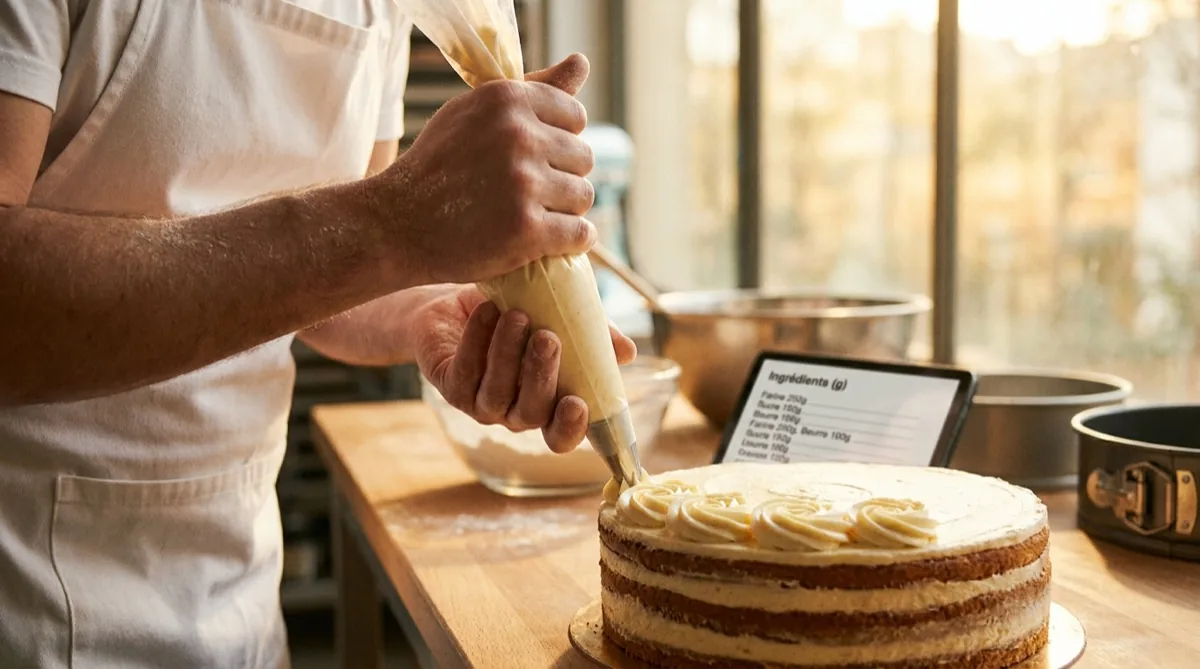
Bakery owners often try to use generic store software. It works for month 1, then the trouble starts. Here's why a bakery is fundamentally different:
- The finished product = a recipe, not bought merchandise. You buy flour, eggs, sugar. You sell a cake that uses precise amounts of them. The software has to know what goes into each product.
- Stock decrements by ingredient, not by product. Sell 1 cake → the software has to decrement 800g flour, 6 eggs, 350g sugar, 250g butter and so on — automatically, per the recipe.
- Allergens are required by law. EU Regulation 1169/2011 requires you to declare every allergen in every product. At an ANPC inspection, missing them = a fine of 1,000–10,000 EUR equivalent.
- Custom orders with a deadline. Custom cakes for next Saturday. Calendar, deposit, status (in progress / ready / delivered).
- Multiple sales channels. A display case for daily products, event orders, possibly online or food delivery. All must draw from the same ingredient stock.
- Production isn't instant. A cake is started on Wednesday, delivered on Saturday. The software has to tell you what to prepare and when, so it's ready on time.
A generic tool retrofitted for bakeries will handle the till — but you'll still keep separate Excels for recipes, a paper order calendar, and labels made by hand. You'll lose hours every day and risk legal penalties.
2. 7 essential features for a bakery
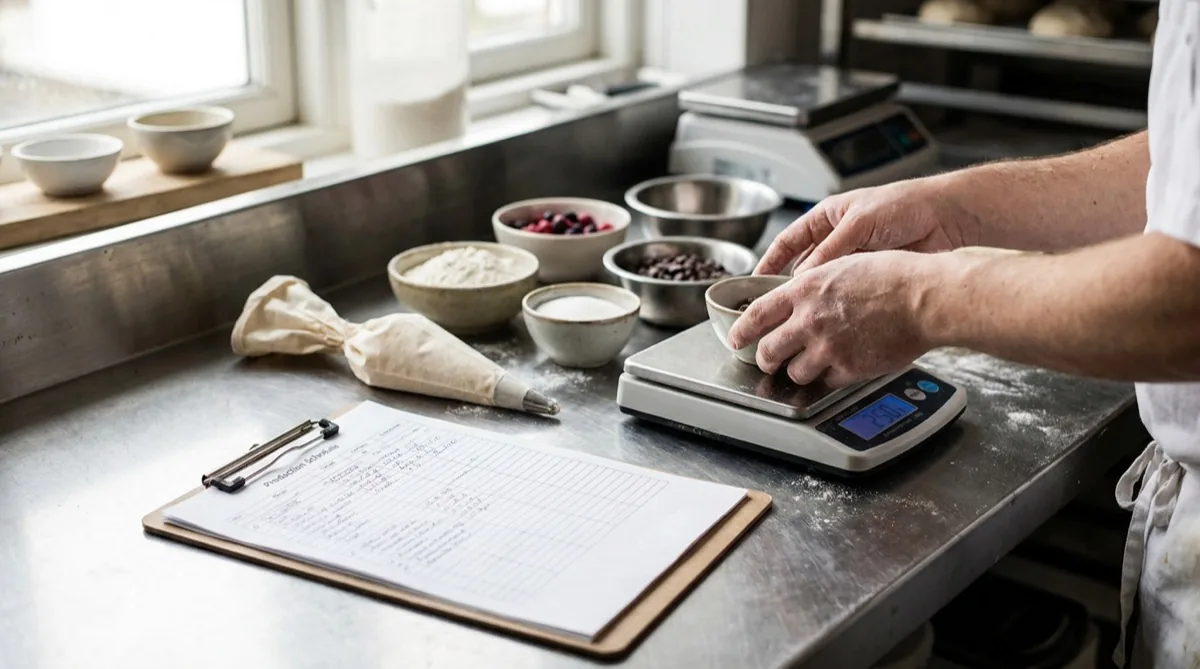
Here are the features a bakery / pastry-focused tool must have — not "roughly," but completely:
- Complex recipes with steps and sub-recipes — A cake uses a cream, which uses a syrup, which uses sugar and water. The software must handle recipes with sub-recipes (not just flat ingredient lists). Change 1 ingredient in the base syrup → every product that uses the syrup updates its cost automatically.
- Production cost calculated automatically from current prices — Buy flour at €0.90/kg today → cake cost updates automatically. You see gross margin per product instantly. Without this, you sell low-margin cakes thinking they're profitable.
- Allergens managed at the ingredient level — Every ingredient carries its allergens (gluten, lactose, eggs, nuts, soy, and so on). When you build a recipe, the software aggregates all allergens for the final product automatically. Swap an ingredient → the product's allergens update.
- Legally compliant product labels — You print a label with: ingredients (in decreasing quantity order), allergens (highlighted), nutritional values, lot, shelf life, storage conditions, producer. All generated automatically from the recipe. Compliant with EU Regulation 1169/2011.
- Event-based order calendar — Mihaela wants a cake for Saturday at 14:00. You log it in the calendar with details (size, decor, allergens, price, deposit). Every morning, the software shows you what to prepare for the next 7 days, in delivery order.
- Planned production and mixing plan — At the end of the day, the software tells you: "tomorrow you need to make 4 X pastries, 2 Y cakes and 8 Z cookies — total ingredients: 6 kg flour, 30 eggs, 2 kg butter." Shopping list and production list in one place.
- Multi-channel with one shared stock — The display case sells ready-made products. Event orders require specific production. Online (if any). All draw from the same ingredient stock, with no duplicates or losses.
3. EU allergens — what the law says and what the software does
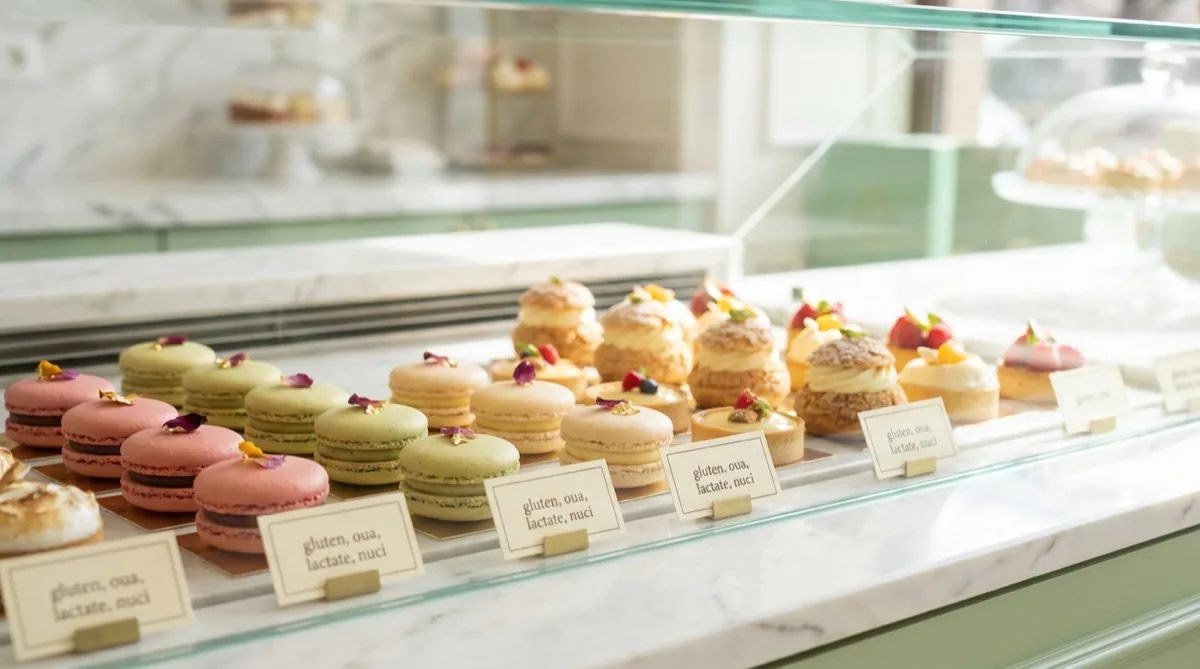
Many owners still underestimate this section. It's the most expensive thing you can leave out.
What the law says (EU Regulation 1169/2011)
Every food business (including bakeries and pastry shops) must declare the presence of the 14 major regulated allergens in any product sold: gluten, crustaceans, eggs, fish, peanuts, soy, lactose, tree nuts (hazelnuts, almonds, pecans, etc.), celery, mustard, sesame, sulphites, lupin, molluscs.
For packaged products (with a label): the allergens are written in bold (or otherwise highlighted) inside the ingredients list on the label.
For products sold unpackaged (the bakery display case): allergens must be displayed visibly — on a sign, in a menu, or printed when the customer asks.
The actual fines
ANPC can issue fines between roughly €1,000 and €10,000 (equivalent) for missing or incorrectly declared allergens. Recent inspections show fines of €2,000+ at small bakeries that "forgot" gluten or eggs on the allergen list. Plus a temporary suspension of activity in serious cases.
What the software must do
- Full list of the 14 allergens at the ingredient level
- Automatic aggregation: when a recipe includes an ingredient with gluten, the product inherits gluten
- Label highlighting per the law (bold for allergens)
- "Allergens across all products" report for display-case signage
- Warning on new recipes: "you haven't tagged the allergens for ingredient X"
4. 5 hidden costs to check before you buy
The same principles as in any industry, but with bakery specifics:
4.1. Extra "recipes" or "production" module
Many tools show €16–€30/month for the base POS. The "recipes with food cost" module is separate, +€12–€20. The "allergens and labels" module — +€8–€12. Real total: €50–€70/month. Insist on the price with everything you need included.
4.2. Initial recipe setup
For an average bakery with 40–80 products, each with a complex recipe, initial setup can take 20–40 hours. Some vendors charge €300–€600 for setup assistance. Ask: "What is the total cost to get started, with my 60 recipes set up?"
4.3. Mandatory label hardware
A bakery label printer is specific (adhesive labels with multiple fields). Some vendors require you to buy from them at marked-up prices (€300–€500 for a printer that costs €120–€180 on the market). Check which standard printers the software supports (Zebra, Brother QL series, Citizen).
4.4. Long-term contract
For bakeries, 12–24 month contracts are common. If the software doesn't fit or can't handle your recipes, you keep paying anyway. Look for contract-free options, billed monthly.
4.5. VAT on the subscription
Check the final invoiced price — what actually leaves your bank account. A "€50" list price can become €60 if the vendor is VAT-registered. At Conexa, prices are transparently listed net of VAT (+ VAT), billed with a full tax invoice by POINT OF BUSINESS SOFTWARE S.R.L. (VAT ID: RO36849440).
5. How to evaluate a tool in 30 minutes
6 bakery-specific demo questions
- "How do I define a recipe with 10 ingredients, 2 of which are sub-recipes (cream + syrup)? Show me how total cost is calculated automatically."
- "If I change the purchase price of butter from €5 to €6.40/kg, how does that show up in the cost of cakes that use it?"
- "How do I print a pastry label with highlighted allergens, nutritional values, lot and shelf life?"
- "How do I log an order with a Saturday deadline for a 4-tier cake? Can I see the production calendar for the next 7 days?"
- "If I make a display-case sale of 5 pastries, how does ingredient stock decrement? Can I see retroactively what was consumed?"
- "Can I close the account anytime and download recipes and customer data (Excel, standard format)?"
3 checks you can do without a demo (from their website)
- Google reviews + "Pastry / Patisserie Romania" Facebook groups. Ask for direct references.
- Terms and conditions — read for 5 minutes. Look for contract length, data lock-in, unilateral price changes.
- Tax ID and company history — check on lista.gov.ro. Is the company VAT-registered? Has it been around for years, or is it a recent startup?
6. Frequently asked questions
How much does a complete bakery software cost?
Realistically, €50–€90/month for a single location, with all features (POS, recipes, allergens, labels, event orders, e-Invoice). Below €40 is suspicious (modules missing). Above €120 is probably oversold.
How long does it take to set up my 50–80 recipes?
With Excel import: 5–8 hours for recipes + 2–3 hours testing production cost. Full transition (team using it fluently): 2–3 weeks. Pick a tool with direct import and setup assistance.
Can I use the label printer I already own?
If it's a standard model (Zebra, Brother QL, Citizen), yes. The software should let you configure the label template (size, visible fields). Ask explicitly about your printer model before you buy.
How does it work with food delivery (Glovo, Bolt, Tazz)?
Some tools have direct integration with delivery aggregators — orders pull in automatically and stock decrements. Others require manual entry. Ask: "Do you have direct integration with Glovo / Bolt Food / Tazz / Wolt?"
Does it have to integrate with e-Invoice / fiscal printers?
Yes, both. The fiscal printer must be ANAF-approved (connected to ANAF). B2B invoices (e.g. invoices to guesthouses or restaurants buying wholesale) must be issued through ANAF e-Invoice / SPV. The software must support both automatically.
Want to see how Conexa handles all this?
Book a 20-minute demo with a specialist who has set up hundreds of bakeries. No pressure, no hard sell — we just show you how Conexa fits your business.
Book a demoRead next
- Guide: How to choose POS software for a retail store
- Guide: How to choose POS software for a restaurant
- Bakery — all Conexa features for pastry shops
- Tablet POS — hardware guide (Android, iPad, ANAF-approved fiscal printers)
Guide written by the Conexa team, based on experience built since 2014 with over 1,200 businesses in Romania. Conexa is management software built for the bakery industry.